Dispatches from the Threshold · MMXXVII

The Grimoire

Mythology · Folklore · Esoteric History · WCC Dispatches

Mythology Ancient History Folklore Protective Magic Mediterranean

The Eye and the Horn: A 5,000-Year-Old Protection System That Never Stopped Working

Ancient evil eye amulets and a traditional Neapolitan cornicello

Ancient protective amulets from the Mediterranean world. Public domain.

Somewhere in the world right now, a grandmother is spitting three times over her grandchild's shoulder. A taxi driver in Naples has a red horn hanging from his rearview mirror. A woman in Istanbul is wearing blue glass at her wrist. A rabbi is whispering a blessing over someone who just received a compliment they did not want.

They are all doing the same thing.

They are all doing what humans have done for nearly 5,000 years.

The Oldest Fear

The evil eye is not a superstition. It is not a cultural quirk. It is not something any single tradition invented and owns.

It is the oldest documented magical belief in human history.

The first written references appear in Sumerian cuneiform texts nearly 5,000 years ago. From there the trail never goes cold. Ancient Egypt. The Hebrew scriptures. Homer. The Quran. Hindu sacred texts. Roman law. Celtic tradition. Every major civilization that has ever left a written record left a record of the evil eye. Every culture that kept no written records passed the belief down through spoken tradition and folk practice until someone eventually wrote it down.

Scholars who study comparative mythology call this kind of universal belief a cultural universal. A concept so fundamental to human experience that it develops independently in societies with no contact with each other. The evil eye is one of perhaps a dozen beliefs that qualify. It does not belong to one culture because it came from all of them.

You cannot appropriate what was always yours.

What It Actually Is

The evil eye is a gaze that harms. Not necessarily intentionally. That is the part people forget.

In most traditions the evil eye is not the weapon of a witch or an enemy. It is the byproduct of envy. Of excessive admiration. Of looking too hard at something good. The belief holds that concentrated desire or jealousy carries energy, and that energy can travel through the eyes and attach itself to whatever is being looked at.

Your healthy child. Your new business. Your beautiful garden. Your good luck.

The ancient Greeks understood this through their theory of vision. The dominant Greek model, held by Pythagoras, Plato, and Euclid, was that the eye does not passively receive light. The eye emits rays outward. The eye reaches out and touches what it sees. This made the evil eye not a superstition but a logical consequence of how vision worked. Of course the eye could harm. It was reaching out and touching things constantly.

Pliny the Elder described people whose gaze alone could wither crops, stop birds mid-flight, and crack precious stones. He was not writing fiction. He was writing natural history.

The Romans were so consumed by the belief they built an entire legal and social architecture around it. Hiring people whose sole job was to stand near public figures and absorb malicious gazes. Carving protective symbols into the prows of ships. Hanging amulets above every doorway and cradle. The Latin word for it was fascinatio. We still use the word today. When you call something fascinating you are reaching back 2,000 years to a Roman who believed he was being bewitched by someone's stare.

The Answer to the Gaze

Every culture that named the evil eye also developed a way to fight it.

The Greeks wore eye amulets to reflect the gaze back at the sender. The Turks developed the nazar boncuğu, the blue glass eye that looks back at whatever is looking at it. The Hamsa hand appeared across the Middle East and North Africa as a palm raised against the malevolent stare. Every tradition reached the same instinct: meet the eye with an eye. Meet the hand with a hand.

In Naples they made a horn.

The Cornicello

The cornicello has been hanging in Neapolitan kitchens, around Neapolitan necks, and from Neapolitan rearview mirrors longer than most nations have existed.

The word means little horn. In Naples it is simply called il corno. The horn. As if there were only one horn worth naming.

The shape is ancient. A long, twisted taper, like a chili pepper grown strange, like an animal horn seen through a fever dream. It connects to multiple older symbols simultaneously: the crescent moon of goddess worship, the horn of the bull sacrificed in ancient Mediterranean ritual, the shape of power drawn thin to a point. Naples was originally a Greek colony. Its protective magic carries Greek bones.

The rules are not decorative. They are the mechanism.

The cornicello must be twisted. A straight horn has no power. The twist is where the protection lives, the same way a spiral holds energy a straight line cannot. You will find this logic across dozens of magical traditions on every continent. The curve, the coil, the spiral. Power is not linear.

The cornicello must be red. Red is the color of blood and life force across the ancient Mediterranean world. Protection requires vitality. A pale horn is a dead horn.

The cornicello must be received as a gift. This is the rule most people violate without knowing it. You cannot purchase your own protection. You can only receive it from someone who wishes you well. The magic is not in the object. The magic is in the intention transferred with it. Buy one for yourself and you have a beautiful piece of jewelry. Receive one and you have a shield.

The Jettatore

Naples developed something no other city quite managed: a precise taxonomy of evil eye practitioners.

The jettatore was a specific type of person believed to involuntarily radiate the evil eye. Not malicious. Not a witch. Simply cursed with a gaze that damaged whatever it rested on too long. The jettatore could not help it. Everyone around them could.

The most famous jettatore in Neapolitan history was Francis II of the Two Sicilies, the last Bourbon king of Naples. His reputation for involuntary bad luck was so widespread that foreign diplomats, dignitaries, and members of his own court would discreetly make the mano cornuta while shaking his hand. The horned hand gesture, index and pinky extended. The gestural equivalent of the cornicello. The oldest apotropaic gesture in the ancient Mediterranean, still being performed in diplomatic reception halls in the nineteenth century by men in formal dress who absolutely knew what they were doing.

The horn did not start as a charm. It started as a hand gesture. The amulet came later, a way to keep your hands free.

Two Halves of One System

The evil eye and the cornicello are not two separate beliefs. They are a single system that has been operating continuously for five thousand years.

One names the threat. One answers it.

One says: concentrated envy is real, it travels, it lands. The other says: here is a twisted red horn someone who loved you pressed into your palm. It has been watching the door ever since.

The fact that this system survived the fall of every empire that practiced it, survived every religious institution that tried to absorb or suppress it, survived globalization and the internet and someone on social media insisting it belongs to only one people, tells you something important.

It works. Or at least, it works in the way that all protective magic works. It gives the holder of the horn something concrete to believe in. And belief, as any practitioner will tell you, is not nothing.

It is, in fact, the whole point.

April 30 – May 2, 2027. Portland, Oregon. witchcraftcon.com

Sources: Sumerian cuneiform records · Pliny the Elder, Natural History · Oxford Classical Dictionary · Folklore Society of Great Britain.


Portland History Esoteric History Rosicrucianism

The Occult Grocer: Fred Meyer and the Secret Life of Portland's Most Famous Businessman

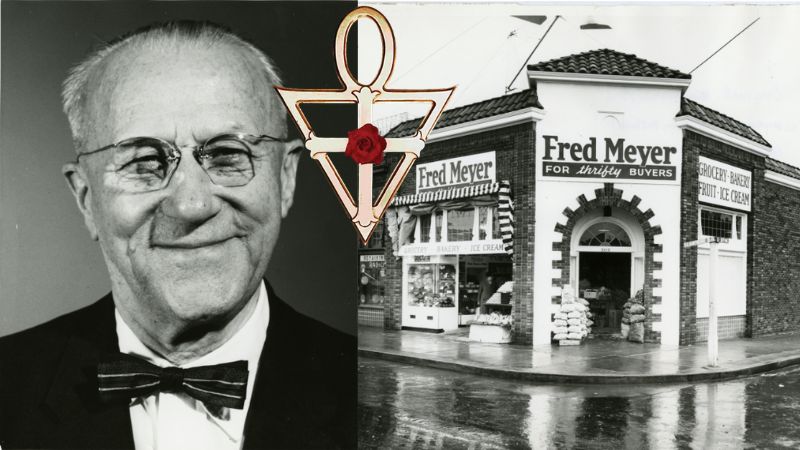
Fred Meyer, his store, and the Rosicrucian rose cross symbol

Fred Meyer, his first Portland store, and the Rosicrucian rose cross symbol he followed for the entirety of his life.

Every time you pull into a Fred Meyer parking lot, you are visiting the legacy of a practicing occultist.

Most Portlanders have no idea.

Frederick Grubmeyer was born in Germany in 1886. His family immigrated to Brooklyn when he was two years old, where his father ran a grocery store. At eighteen he struck out on his own, tried gold mining in Alaska in 1905, went broke, and moved to Seattle. Living at the YMCA, he met Max Heindel, the guiding force behind the Rosicrucian Fellowship, a religious philosophy and membership that Meyer quietly supported for the rest of his life.

That meeting changed everything.

Heindel was one of the most significant occult figures of the early twentieth century. A former Theosophist who claimed to have received his teachings directly from a Brotherhood of Elder Brothers near the border of Bohemia and Germany, he founded the Rosicrucian Fellowship in 1909 with the stated aim of heralding the Aquarian Age and promulgating the true philosophy of the Rosicrucians. The Fellowship married esoteric Christianity with astrology, reincarnation, and a rigorous system of spiritual self-development. It was not a fringe curiosity. At its peak, Heindel was lecturing to audiences of nearly a thousand people at a time in Los Angeles.

For Meyer, the key principles included clean living, a relentless search for facts, belief in reincarnation, and a desire to help others. He brought all of these into his business. Heindel's pragmatic tenets clearly influenced Meyer, who made time for daily mindfulness practice and based his business decisions on evidence rather than his gut, from a place Heindel called the Region of Concrete Thought.

Read that again. The man who built one of the largest grocery chains in the Pacific Northwest made his business decisions from a place called the Region of Concrete Thought, a concept drawn from Rosicrucian cosmology. While other executives were running numbers, Fred Meyer was consulting an esoteric framework for accessing higher knowledge.

He bought a small coffee business in Portland in 1909, the same year Heindel founded the Fellowship, and never looked back. The grocery empire followed. The name above the door changed. The beliefs never did.

When Meyer died in 1978, his remains were handled according to the Rosicrucian Fellowship. His body was kept for 84 hours so that his karma-filled seed-atom could ascend properly. The seed-atom would then inhabit the head of a spermatozoa so it could enter another human being during conception and be reborn with its previous life's wisdom intact.

He was not alone in this city. In 1920, the Oregonian declared three essentials for every modern Portland home: a percolator, an electric iron, and a Ouija board. Portland was a spiritualist hotbed where grocery store tycoons subscribed to reincarnation and congressmen's wives hosted séances. The Theosophical Society had been operating in Portland since 1911. The Rosicrucians were meeting regularly. Spiritualists were holding circles in hotel lobbies and private parlors across the city.

This was not the fringe of Portland society. This was Portland society.

The same city that passed Ordinance 80449 in 1944 to criminalize "any other mysterious or unscientific practice" was, just two decades earlier, a city where the most powerful businessman in town believed in reincarnation, consulted an esoteric philosophy to make his decisions, and arranged his death rites according to occult tradition.

Portland has always contained multitudes. WitchcraftCon is the continuation of a conversation this city has been having for well over a century.

April 30 – May 2, 2027. Portland, Oregon. witchcraftcon.com

Sources: Oregon Encyclopedia · Portland Monthly · Rosicrucian Fellowship records.


Mythology Gods & Figures Misattribution

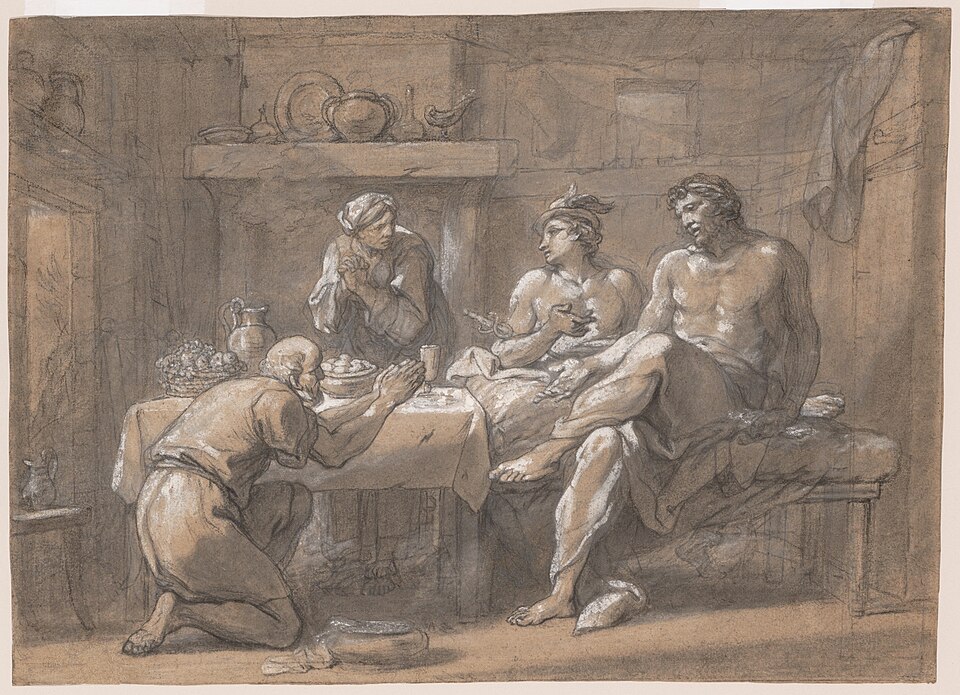
The Wrong Drunk God

Silenus in Disney's Fantasia, 1940

Silenus in Disney's Fantasia, 1940.

Here is something that will bother you the next time you watch Fantasia.

That fat, jolly, grape-hat-wearing disaster stumbling through the Pastoral Symphony? The one falling off his donkey while everyone laughs? That is not Dionysus. That is Silenus. Dionysus's tutor, oldest friend, and most enthusiastic drinking buddy.

They are not the same guy.

Dionysus is young, beautiful, and genuinely frightening. He is the god who drove women into the mountains to tear a king apart with their bare hands. His wine is not happy hour. It is transformation. Dissolution. The kind of ecstasy that makes civic authorities very nervous.

Silenus is the one who raised him, educated him, and has been falling off a donkey drunk since before most of the Olympians were born. He is enormous, perpetually intoxicated, and surprisingly wise in the way that people who stopped caring what anyone thinks eventually become. The Greeks found him hilarious. They also occasionally asked him serious questions, which he answered well. There is a story in which King Midas captures Silenus and demands to know what is the greatest thing a human being can know. Silenus laughs for a long time. Then he tells Midas that the greatest thing is not to have been born at all, and the second greatest is to die as soon as possible. A fat drunk satyr on a donkey just handed you the darkest philosophy you have ever heard. The Greeks were not playing around.

Roman artists started collapsing the two together. Disney finished the job.

The fat jolly wine god is a folk simplification. Take the most recognizable symbol, the wine and the excess, give it a body that says this man has not seen his feet in years, remove the danger, add a donkey. You get Silenus.

You get a great character. Just not the one on the label.

Pour one out for Silenus. He earned it.


Portland History Law & Resistance Persecution

They've Always Come for the Witches

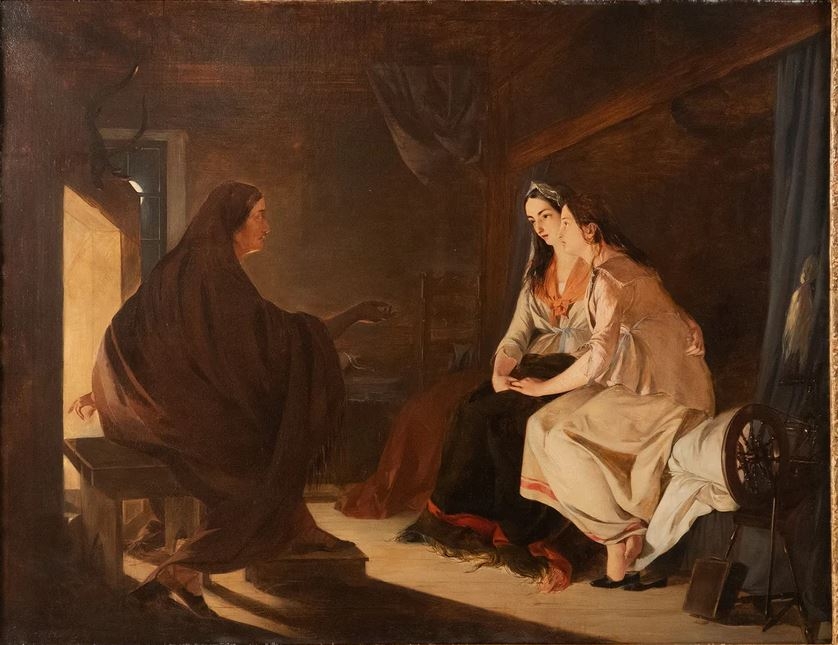
A fortune teller consulting two young women, 19th century oil painting

Fortune teller consulting two women, 19th century oil painting. Public domain.

Portland has always had its people on the edges.

Not the edges of respectability, the edges of the ordinary. The people who read rooms differently, who trusted something older than consensus reality, who lit candles with intention and shuffled cards with reverence. They were here before Portland was a city worth writing about. They have never left.

And the law has never quite known what to do with them.

In the early twentieth century, Portland's police code already contained language prohibiting fortune telling. By 1944, the City Council decided that law wasn't strong enough and passed Ordinance No. 80449, a sweeping revision that expanded the definition of fortune telling to cover what feels like almost every form of esoteric practice imaginable. Clairvoyance. Cards. Phrenology. Psychometry. Palmistry. Mediumship. Spiritualism. Seership. Prophecy. Charm. Potion. Oriental mystery. Magic of any kind or nature. And just to make sure nothing slipped through, the ordinance closed with a catch-all phrase covering "any other mysterious or unscientific practice."

Any. Other.

The city was thorough. They were also, it turns out, not always successful.

Somewhere in that same era, two Portland women named Mrs. V. Kropp and Mrs. W. R. Wrenn sat in a municipal courtroom and refused to be convicted. They were Spiritualists, practitioners of a tradition that had millions of American adherents and established churches and ordained ministers. They had advertised their services. The police had noticed. The charges came down under Portland's fortune telling and deception ordinance.

Their attorney made a simple argument. What these women did was religion. The counsel, the listening, the guidance they offered their clients was no different from what any minister offered any congregation on any Sunday morning. The judge agreed. Both women walked out of that courtroom acquitted.

It was a small and quiet victory in a city that barely paused to notice it. But here is what that moment actually was. Two women who practiced something the establishment found threatening stood in a courtroom and named it sacred. They did not soften it. They did not reframe it as something more palatable. They said: this is what we do, this is what it is, and you do not have the authority to call it a crime. Their names deserve to be remembered.

Spiritualism itself is worth understanding because it tends to get flattened into stereotype. The movement had taken hold in America in the 1840s, built around the belief that the living could communicate with the dead and that the spirit world was not separate from everyday life but woven through it. By the early twentieth century it had tens of millions of adherents. Women found particular power in it. In a world that gave them almost no public authority, the role of medium made a woman the center of a room, the conduit for wisdom, the one everyone listened to. That is precisely why it threatened people in power. And that is precisely why the laws kept coming.

Those laws had deep roots. Anti-fortune telling statutes echoed anti-vagrancy and anti-witchcraft laws stretching back to at least the sixteenth century. The pattern never really changed. Call it fraud. Call it deception. Call it unscientific. The effect was always the same: keep certain kinds of knowing underground, keep certain kinds of women quiet, keep the boundary between acceptable belief and dangerous knowledge firmly in place.

You might think we've moved past this.

We haven't.

In October 2023, Beck Lawrence opened a small metaphysical shop called Serpent's Key Shoppe and Sanctuary in Hanover, Pennsylvania. The shop featured a community altar to Hekate, essential oils, crystals, local art, and tarot card readings. Lawrence gave a friendly interview to a local newsletter, talked about what they sold, and invited people to come in.

A few days later, the police chief of Hanover, Chad Martin, personally read the newsletter article and took issue with it. Two officers entered the store and backed Lawrence into a corner. The message was clear. Fortune telling has been illegal in Pennsylvania since 1861, punishable by up to a year in jail and a $2,500 fine.

Lawrence posted about the encounter on TikTok. It went viral, with millions of views. A lawsuit was filed. A petition gathered thousands of signatures. The community showed up. Tarot readers across Pennsylvania started quietly wondering whether they were next. That is the intended effect of these laws, by the way. Not necessarily prosecution. Intimidation. Uncertainty. The slow erosion of a community's willingness to practice openly.

Oklahoma, Wisconsin, Minnesota, and North Carolina still ban tarot readings and fortune telling outright. Massachusetts requires a license to practice. The laws are old but they are not dead. And as Beck Lawrence found out, all it takes is one person in power with a personal agenda to turn a law that hasn't been enforced in decades into a weapon.

Portland's witches and practitioners and seers have been here the entire time. Through every ordinance, every crackdown, every municipal council that decided their practices needed more aggressive prohibition. They gathered in parlors and tea rooms and back rooms and living rooms. They read cards and cast circles and called on the dead and the divine. They kept their traditions alive in a city that alternately tolerated and prosecuted them.

WitchcraftCon is being built for their descendants. For everyone who has ever practiced quietly because practicing openly felt like a risk. For the tarot readers who put up "entertainment purposes only" signs not because they believe that, but because they have learned to protect themselves. For the community that has always been here and has never had a festival that truly belonged to it.

April 30 – May 2, 2027. Portland, Oregon. witchcraftcon.com


Mythology Hexennacht Beltane Witch Night

Hexennacht · The Night Before Beltane

April 30th is Hexennacht. Witch Night. The spring mirror of Samhain, and the more honest name for what this night has always been. Where October 31st marks the thinning of the veil as the year turns toward darkness, April 30th marks the thinning as the year turns toward light. In Germanic tradition, this was the night witches were believed to gather on mountaintops, lighting fires to welcome summer and drive the last cold of winter from the land. Brocken mountain in the Harz region of Germany was the most famous gathering place. The fires were not celebrations of darkness but of fire itself — the returning sun, community against the last of winter's grip, the recognition that the world was about to change.

The folk name tells you exactly what the church spent centuries trying to erase. Hexennacht. While a Christianized name was imposed after 779 CE, ordinary people kept calling this night what it was: Witch Night. That persistence is not trivial. It is evidence of how completely the pre-Christian understanding of this date was embedded in the culture. You cannot rename a night and change what it is. The folk memory always survives underneath.

The Christianized name comes from Saint Walpurga, an English missionary nun who traveled to Germanic lands specifically to suppress folk magic and pagan practice. She was canonized on May 1st, 779 CE — a date chosen to place a Christian saint directly over the existing observance. Walpurga did not celebrate what happened on the night before her feast day. She spent her life working against it. Naming this night after her was not an accident. It was a statement of ownership over something the church could not destroy. WitchcraftCon has no interest in that statement.

In Goethe's Faust, this is the night Mephistopheles takes Faust to the Brocken to witness the witches' sabbath. In Scandinavian tradition, it is Valborg — a night of bonfires and singing. In Finland, it is Vappu, a celebration of spring so beloved it became a national holiday. In the Czech Republic, witches are burned in effigy to drive away evil before May arrives. The same night, the same instinct, the same recognition that something turns here. No matter what name was placed on top of it.

Beltane follows at dawn. The fire festival of the Celtic calendar. The halfway point between the spring equinox and the summer solstice. The day when cattle were driven between two bonfires to purify them before the summer pasture. When the young went out into the woods and came back with May flowers. When the world was understood to be at its most fertile, its most alive, its most open to possibility.

WitchcraftCon opens on Hexennacht and closes on the day after Beltane. We did not choose these dates because they are evocative, though they are. We chose them because this is when Portland's pagan and esoteric community already understands that something significant is happening. The calendar has always called for this gathering. We are simply building it.

Magic is afoot in Portland. April 30 – May 2, 2027.


More entries coming soon. Mythology. Folklore. The making of WitchcraftCon. The traditions that shape the programming. The people building this with us.

Join the list to receive new Grimoire entries directly.

Join the Coven List

We would love to hear from you. Every conversation begins with curiosity.

Sinister Concept

Producer · WitchcraftCon · Portland, Oregon

Telephone503.381.5308

Portland · Oregon · MMXXVII